About César Bazaar
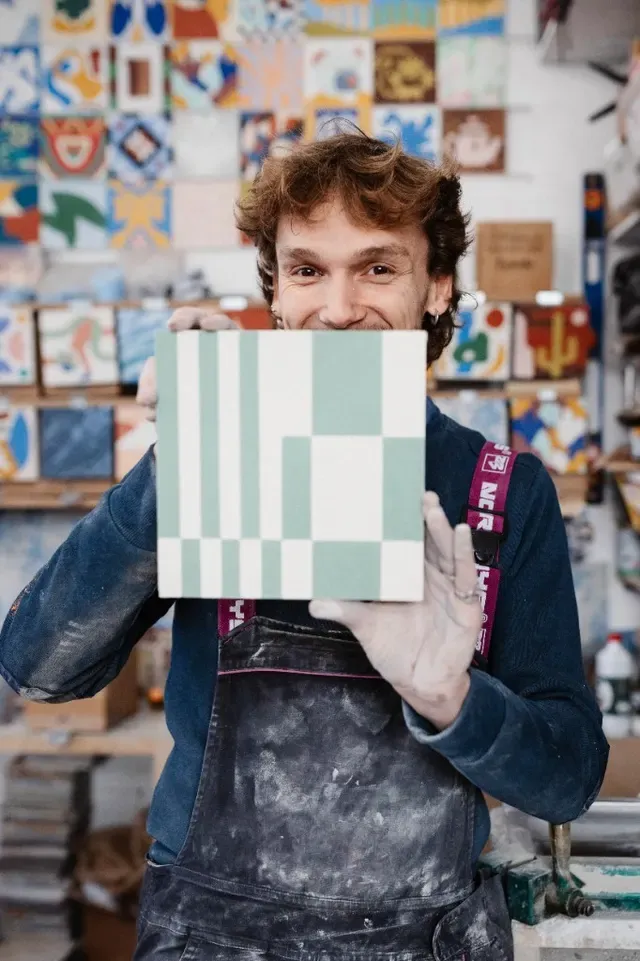
Photo credit: Gabrielle Gayraud
A craftsman reinventing cement tile
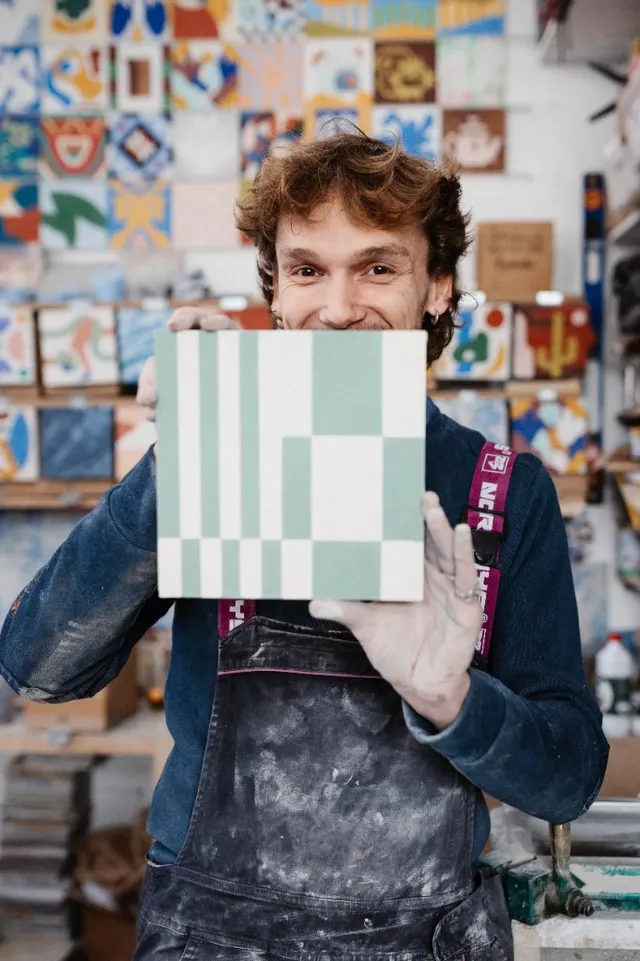
My name is César Leblic. I used to develop video games; I left that behind to devote myself to a material that fascinates me: cement tile. I founded César Bazaar in Pantin, just outside Paris, where I design and make tiles by hand, one at a time, in a workshop I think of as much as a laboratory as a place of production.
My work rests on one belief: cement tile is a medium in its own right, not merely a surface finish. As one of the last heirs in France to a know-how that emerged in the nineteenth century, this material is often locked into narrow uses and looks. My approach is to question it again—formally, functionally, symbolically, and technically.
What I do
Since I started, I have developed more than eighty cement tile collections, alone or with artists, graphic designers, illustrators, architects, students, and homeowners. Each pattern is conceived as a work in itself, and each collaboration opens a new angle on this medium.
My tiles end up in all kinds of interiors: floors, walls, home kitchens, architects’ projects, bespoke commissions. Some now pave the floor of the Élysée Palace in Paris.
I do not stop at traditional cement tile. I also explore unexpected ground: paper tiles made from waste (winner of the FAIRE competition, shown at the Pavillon de l’Arsenal and the Emergence biennial), Magma tiles—a new material somewhere between cement tile, zellige, and marbled paper—and experiments from embedding scent to edible tiles made with a baker 😅.
A workshop open to everyone
The workshop is designed as an open space, welcoming every audience. Each year, more than six hundred people—members of the public, design students, high-school pupils, children, architects—come to discover, handle, and make their own tile.
I work regularly with students from ENSAAMA, LISAA, DNMADE, and vocational high schools. I also run workshops for middle-schoolers with the association De l’or dans les mains. The workshop becomes a place of hands-on learning, where making a cement tile means becoming aware of gesture, time, and the weight of things.
Inspired by the Indian Athangudi method, I developed a mobile setup to make tiles anywhere, without a hydraulic press, using raw materials available locally. In 2024, I undertook a tour of France focused on cement tile, running workshops at each stop. In 2026, I am travelling through Mexico to meet cement tile makers while offering itinerant making workshops for children (with support from the Institut français).
The workshop is also open online through Instagram, where I share my daily life as a maker, my research, my travels, and my experiments with a community of more than 60,000 people (I feel very lucky 🥰).
Journeys of craft exploration
Travel is central to my research. I go into the field to learn from craftspeople who keep traditional techniques alive—techniques that are absent or lost in Europe.
In Morocco, India, Vietnam, and Mexico, these encounters are moments of exchange, mutual transmission, and close observation of gestures, tools, and knowledge. I do not try to copy these techniques exactly, but to draw from them to feed my own practice, compare my methods with other ways of making, and adapt my processes to the materials available where I work.
That constant movement between past and present, here and elsewhere, opens paths where craft becomes a space for reflection, creation, and innovation.
Zero waste and solidarity
I try to make every gesture count. All production residues are turned into oversized chalk sticks sold on a pay-what-you-can basis for Secours Populaire (a French charity).
The annual Carreau Solidaire competition invites everyone to submit patterns: the most popular ones are produced and sold, and proceeds go to organisations such as SOS Méditerranée. In 2024, €2,730 was donated through these design-and-recycling campaigns, and in 2025, €4,250.
For some collections, all profits go to charity—for example the Amour collection, whose proceeds go to SOS Méditerranée.
Between heritage and experimentation
My work sits at the crossroads of tradition and contemporary research. That means trying new compositions, subverting established uses, bringing in other materials—recycled paper, scent, embedded objects—or questioning the manufacturing process itself.
The tile becomes a surface for writing, a sculptural module, a carrier of stories or sensations. The aim is to make readable what is often hidden: processes, constraints, environmental impact.
I am currently developing an online course to learn how to make cement tiles at home, with minimal equipment, based on a nomadic technique I developed. The goal is to make the medium accessible to artists, creatives, and teachers so they can own it and pass it on. The project is still in development and should launch in late 2026 🤞.
Who I work with
César Bazaar works with homeowners, architects, interior designers, artists, and designers. Each project is a collaboration, with attention to quality, coherence, and the singularity of the result.
My ambition is clear: to reach among the highest levels of quality in the world (I think, modestly, we are there 😅), while keeping the freedom to experiment, share, and keep alive this extraordinary material that is cement tile.
This website
This site is a project that matters to me. Here I gather what I know about cement tiles—from day-to-day care to protective treatment, through making, history, patterns, and much more. Each article is written with care, from my experience as a maker, my research, and the questions clients ask me every day.
The guide keeps growing. New articles appear regularly. If you have a question that is not covered yet, feel free to get in touch—there is a good chance it will become a future article. If the answer is already on the site, please forgive me if I do not reply (I am drowning in email, which is partly why I built this site 😅).
Contact
César — Founder, César Bazaar
📧 coucou@cesarbazaar.com
📞 +33 6 89 70 86 41
🌍 www.cesarbazaar.com
📍 190 avenue du Général Leclerc, 93500 Pantin, France
📸 Instagram