Cement tile encyclopedia
Everything about cement tile
Manufacturing, installation, treatment, care, pricing.
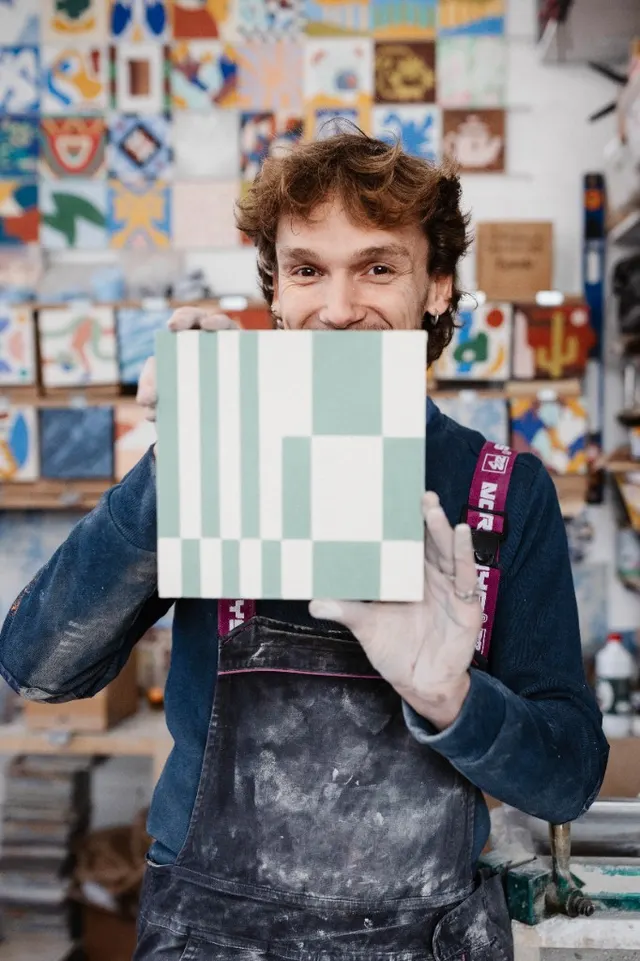
Hi, I'm César 👋. I've been making cement tiles by hand since 2020 in my workshop in Pantin (just outside Paris), and I'm using this site to gather everything I learn about this material. No fluff, no sales pitch — just clear answers to the questions you actually have.
- Articles
- 140+
- Topics
- 15
- Workshop
- Pantin · 2020
Quick answers
The 12 questions I get asked most often — short answers, with a link to the full guide if you want to dig in.
What is a cement tile, exactly?
A handmade, unfired tile made of cement, sand, marble powder and mineral pigments. The 5-6 mm coloured layer is poured into a small partitioned mould (the "divider") sitting on top of the tile mould. We then add dry mortar, a structural backing, and press it under a hydraulic press. The tile cures naturally over several weeks — no kiln, no glaze, just mineral chemistry.
Full manufacturing guide →How is it made?
By hand, step by step: coloured slip → divider → dry mortar → backing → hydraulic press → 1 to 4 weeks of air curing. No firing, no glaze. The know-how dates back to the 1850s and has barely changed since — only the presses got stronger. In my workshop I mostly use brass moulds (classic European method) and I also experiment with the Athangudi method from southern India.
See every step →How is it different from regular tile or encaustic?
Regular tile (porcelain, stoneware, faience) is fired at 1100-1300 °C; cement tile is cold-pressed. Encaustic is an Anglo-Saxon technique: fired clay with inlaid coloured clay in a recessed pattern. The three are often confused but they're completely different processes. The visible difference: a real cement tile has its colour 5-6 mm deep into the body — a printed porcelain imitation has the pattern only on the surface.
Detailed comparison →How much does it cost per square metre?
Expect €80-150/m² for genuine artisan cement tiles, €150-350/m² for custom or premium. On top of that: installation (€60-90/m² with an experienced tiler) and treatment (€5-15/m²). If you see "cement tiles" advertised at €25/m², it's almost always printed porcelain — different material, different lifespan.
All pricing benchmarks →Can I use them in a shower, kitchen, or outside?
Yes to all three, with conditions. Kitchen and backsplash: a classic, just wipe acidic spills (lemon, vinegar, wine) quickly. Shower and bathroom: yes, with a properly maintained water-repellent + oil-repellent treatment. Outdoors: yes in sheltered, frost-free zones. Cement tile fears severe frost and acids — beyond that, it lives well almost anywhere.
Room-by-room guide →How are they installed?
Trickier than regular tile, but doable for a careful tiler. Essentials: a perfectly flat substrate, double buttering with flexible C2 adhesive, full-bed setting without vibration, tight 1-2 mm joints with grout slurry. Cement tile is thick (15-20 mm) and hand-calibrated, so the method needs to adapt — especially the adhesive and layout. Not a Sunday DIY job.
Full installation guide →Do I have to seal them?
Yes, always. A bare cement tile is very porous: it absorbs water, coffee, oil, and stains instantly. A penetrating sealer is non-negotiable, ideally applied before or during installation, then refreshed. Depending on the room, add a water-repellent (wet areas) and oil-repellent (kitchen). Skip this and you'll regret it the first week.
Treatment guide →How do I clean them day-to-day?
Water and a mild soap, that's it. Neutral pH: black soap, Marseille soap, or a dedicated cleaner like FILA Cleaner Pro. Well-wrung mop, done. Never use bleach, vinegar, anti-limescale or descaler — those acidic or alkaline products eat the coloured layer. Rule of thumb: if it strips, it harms cement tile.
Care guide →How do I restore old tiles?
Diagnose first. If the coloured layer is still 3 mm or more, you can sand it down (progressive grit 80 → 400 → 800), seal, and finish with wax — the floor regains its glow. If some tiles are broken, you can replace them with custom reproductions. Avoid tile paint: it's a stopgap that flakes off in 2-3 years and is then a pain to remove.
Renovation guide →How can I tell a real cement tile from an imitation?
Three quick tests: 1) thickness — a real one is 15-20 mm, a porcelain imitation 8-10 mm; 2) the back — a real one has a granular mortar backing, an imitation has a smooth printed back; 3) weight — a real 20×20 cm tile weighs about 1.5 kg, an imitation half that. And crucially: on a real cement tile the pattern goes 5-6 mm deep into the body — on an imitation it's printed on the surface and wears down.
Spotting a real cement tile →Are cement tiles eco-friendly?
Mostly yes, with caveats. No firing means very little energy in production (30-50 times less than fired tile). Materials are 100 % mineral and can be sourced locally. And longevity is measured in centuries — I've seen floors laid in 1900 that just need sanding to live another fifty years. The honest caveat: Portland cement has a real carbon cost; you have to weigh it against the actual lifespan.
Honest ecological assessment →Where can I buy quality cement tiles?
Favour artisan workshops over mass resellers. In France there are several active workshops (mine in Pantin among them). Morocco, Spain, Portugal and Vietnam are also great. Ask where exactly the tiles are produced, ask about the press, the recipe, the pigments — a serious maker is happy to tell you. If they only talk aesthetics, that's a red flag.
Buying guide →Browse by theme
15 main topics, ~140 articles. Each cluster has a pillar guide as the entry point and detail articles inside.
Who writes this site
César Bazaar
Cement-tile maker · Workshop in Pantin (Greater Paris) since 2020
I make cement tiles by hand, one at a time, in a workshop I set up in 2020. I started by going to see how others did it — Morocco, India, Spain, Vietnam — and kept what felt the most honest. I'm still learning, still testing, and gathering here whatever feels genuinely useful to share 🥰.
Techniques I practice
- Hydraulic pressing with brass moulds (classic European method, late 19th c.)
- Athangudi method (South India, studied on site)
- Mineral pigments, marble powder, white Portland cement
- Restoration and reproduction of antique tiles (19th-20th c.)
Recent articles
Latest additions to the encyclopedia.